Rate Limiting: Protect Your API from Abuse with Redis
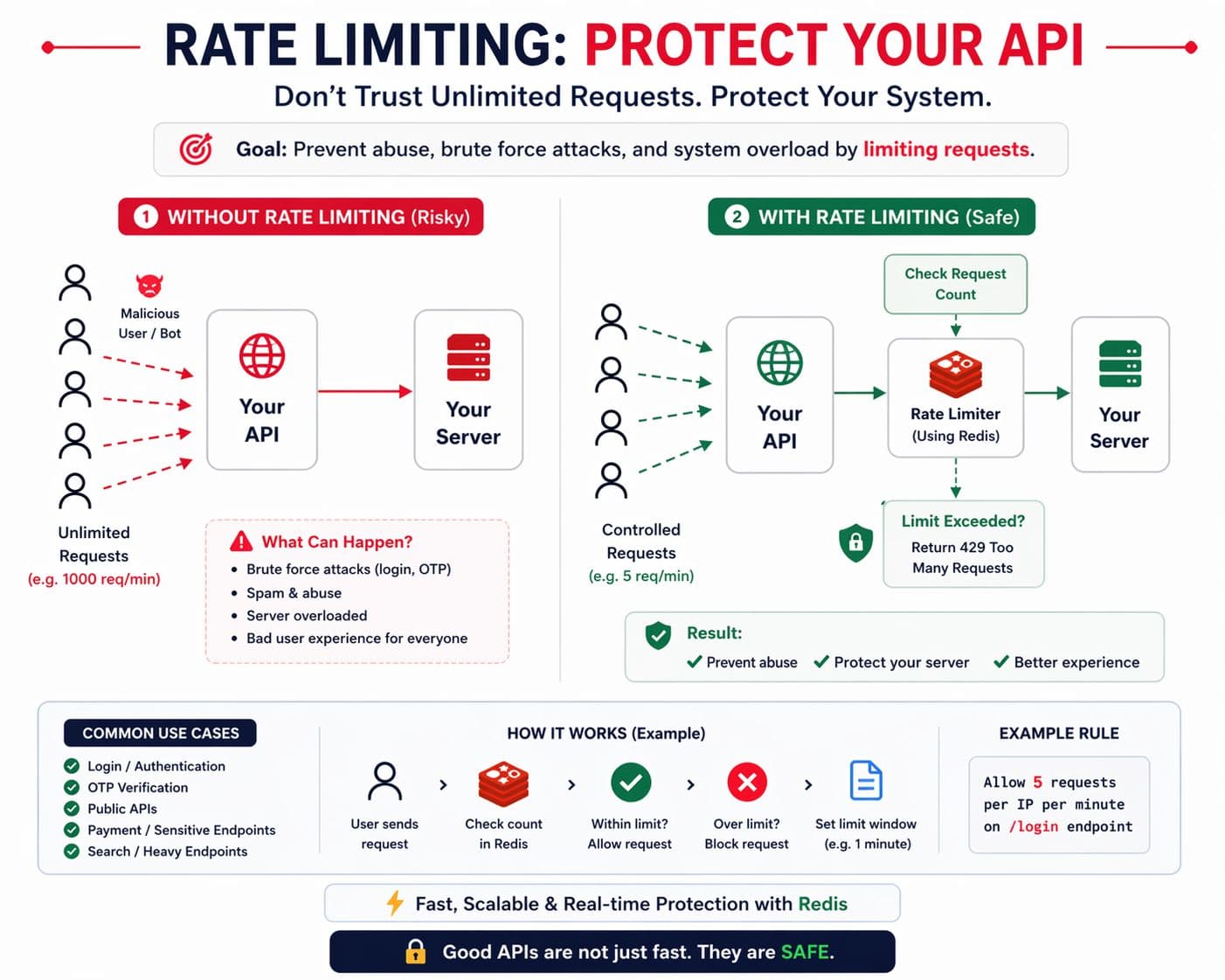
APIs are the backbone of modern web applications, but exposing an endpoint without protection is like leaving your front door wide open. Without limits, a malicious bot — or even a poorly configured client — can overwhelm your servers with thousands of requests per second.
This leads to brute force attacks, server crashes, and a terrible experience for your legitimate users.
The solution? Rate Limiting.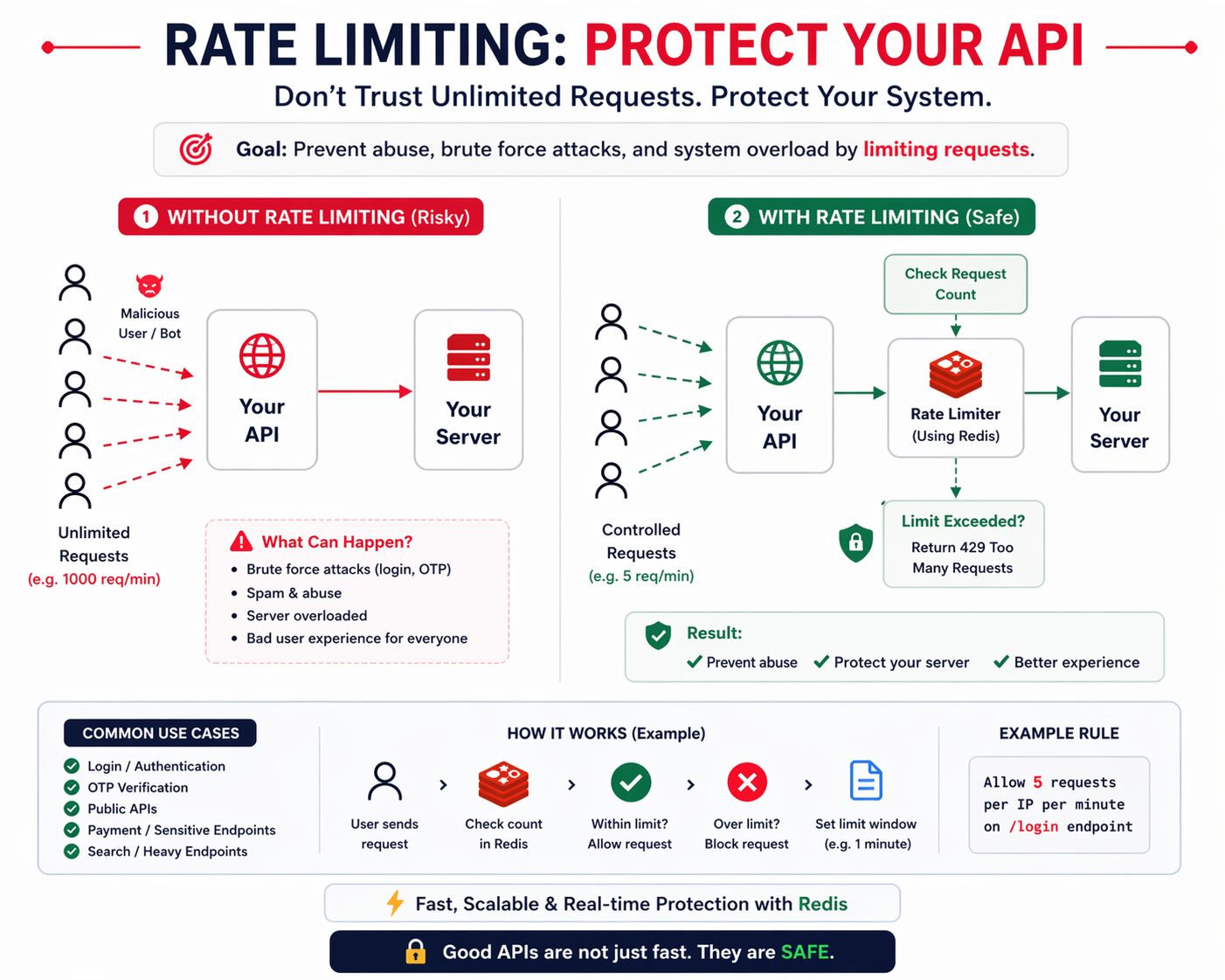
Why You Can't Trust Unlimited Requests
When you build an API, it's tempting to think only about the "happy path" where users make a few requests at a time. But in the real world:
- Brute Force Attacks: Hackers will try to guess passwords or OTPs by hitting your
/loginendpoint thousands of times. - Spam & Abuse: Malicious actors can scrape your data or spam your endpoints.
- Server Overload: Too many requests will consume all your CPU and database connections, causing downtime.
How Rate Limiting Works
Rate limiting is a technique to restrict the number of requests a client can make within a specific time window.
Instead of letting a user send 1,000 requests per minute, you might limit them to 5 requests per minute on a sensitive endpoint like /login.
The Redis Advantage
To implement rate limiting effectively, you need a system that is incredibly fast and highly concurrent. This is where Redis shines. Since Redis is an in-memory data store, checking and incrementing a user's request count takes less than a millisecond.
Here is the typical flow:
- User sends a request.
- Check count in Redis: The server checks how many requests this IP or user ID has made in the current time window.
- Within limit? Allow the request to proceed.
- Over limit? Block the request and return a
429 Too Many RequestsHTTP status code.
Common Use Cases for Rate Limiting
You don't need to apply the exact same limits to every endpoint. Here is how I structure rate limiting for production applications:
- Login / Authentication: Extremely strict (e.g., 5 requests per minute) to prevent password guessing.
- OTP Verification: Strict (e.g., 3 requests per 5 minutes) to avoid SMS/Email spam costs.
- Public Data APIs: Moderate (e.g., 100 requests per minute) to prevent data scraping.
- Payment Endpoints: Strict, to prevent fraudulent transaction attempts.
Conclusion
Good APIs aren't just fast — they are safe. Implementing rate limiting with Redis is one of the highest-impact security measures you can add to your backend. It's relatively easy to set up, scales effortlessly, and protects your infrastructure from day one.
 I'm Ananta Sharma, a Backend and AI Automation Developer from Pokhara, Nepal. I build secure APIs, integrations, controlled AI workflows, and custom software.
Available for backend projects on Upwork and Fiverr. Connect on GitHub or LinkedIn.
I'm Ananta Sharma, a Backend and AI Automation Developer from Pokhara, Nepal. I build secure APIs, integrations, controlled AI workflows, and custom software.
Available for backend projects on Upwork and Fiverr. Connect on GitHub or LinkedIn.